
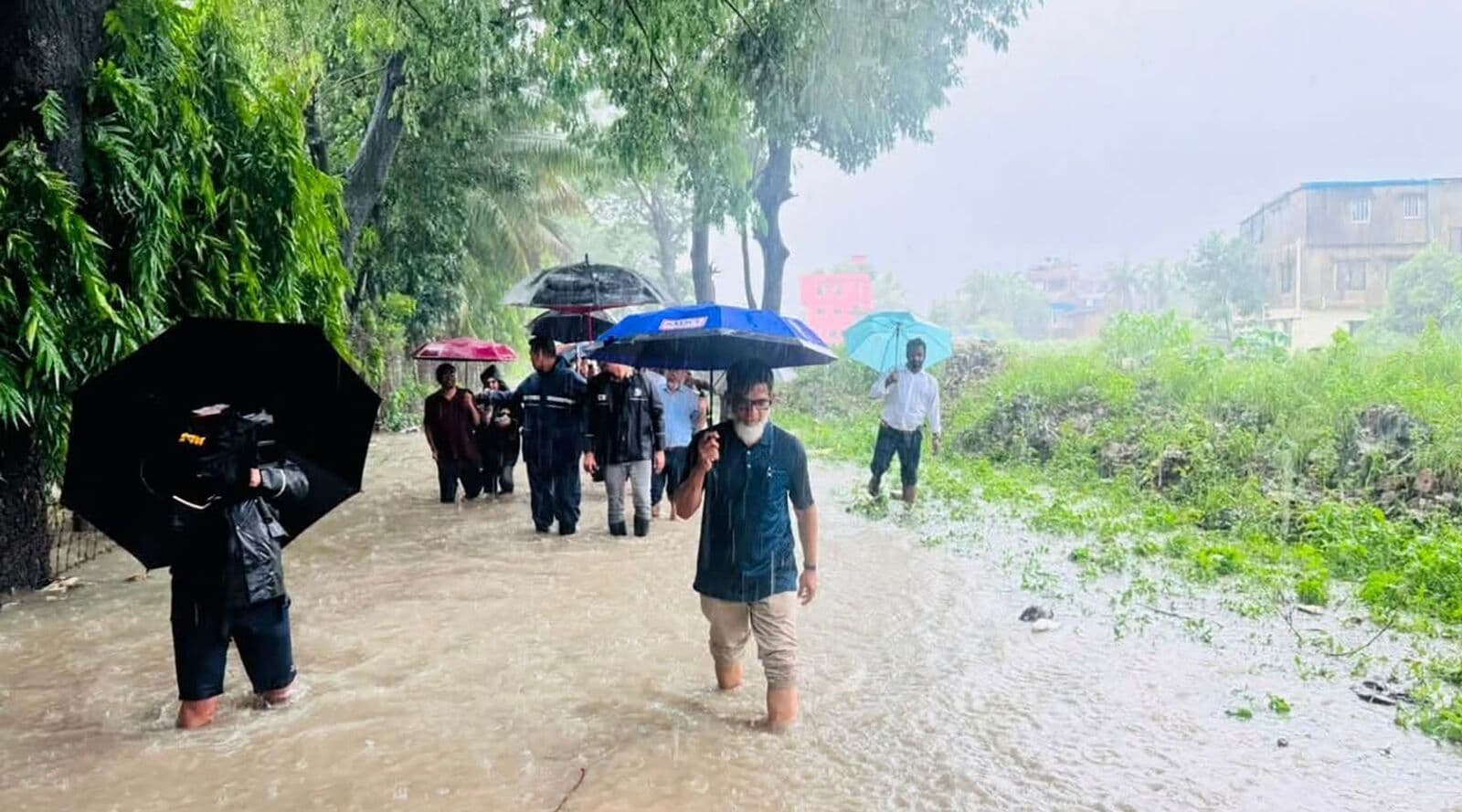
 Photo: Press Information Department, Public Domain
Bangladesh Floods
Overview
Beginning on July 7, 2026, a low-pressure system over the North Bay combined with an unusually strong monsoon flow to dump extraordinary amounts of rain on southeastern Bangladesh. The Flood Forecasting and Warning Centre recorded 815 millimetres in Chattogram, 518 millimetres in Lama and 330 millimetres in Cox's Bazar over just three days, sending rivers in two of Bangladesh's four major river basins past danger levels and inundating hillsides, low-lying farmland and densely packed urban neighbourhoods.
The death toll rose to 59 as of July 19, according to the IFRC, after Bangladesh's Ministry of Disaster Management and Relief had confirmed 51 deaths and 39 injuries as flooding and landslides swept across Chattogram, Cox's Bazar, Bandarban, Rangamati, Khagrachhari, Moulvibazar and Habiganj districts. Cox's Bazar recorded at least 28 deaths, most of them in the Rohingya refugee camps — including 16 refugees killed in a separate series of slope failures across the Ukhiya and Kutupalong mega-camps. In the ministry's earlier count, Chattogram recorded 13 deaths, Bandarban six, Rangamati three and Moulvibazar one. The Chattogram divisional commissioner's office estimated that 267,918 families were marooned, roughly 80,000 homesteads were damaged or destroyed, 344 educational institutions were inundated, and floodwaters washed out 3,840 kilometres of road and 339 bridges and culverts. UN and IFRC reporting from July 12–18 put about 38,500 people displaced in more than 1,000 shelters, and Oxfam counted more than 1.1 million people affected across 10 districts.
The Bangladesh Army, Fire Service and Civil Defence, Border Guard Bangladesh and the Bangladesh Red Crescent Society are running search-and-rescue operations, distributing food, water and emergency shelter, and evacuating families from the highest-risk hillsides. International humanitarian agencies — including Save the Children, CARE Bangladesh, the International Federation of Red Cross and Red Crescent Societies (IFRC), UNHCR and UNICEF — have scaled up child-protection, health and WASH services across the flood belt and the Rohingya camps. The IFRC allocated CHF 899,498 for a relief operation that runs until January 31, 2027.


At a Glance
- Status
- Recovery
- Severity
- Critical
- Type
- Flood
- Affected
- 1,100,000+
- Responders
- 5 orgs
- Started
- July 7, 2026
Share
Help spread awareness about this disaster and the organizations responding.