
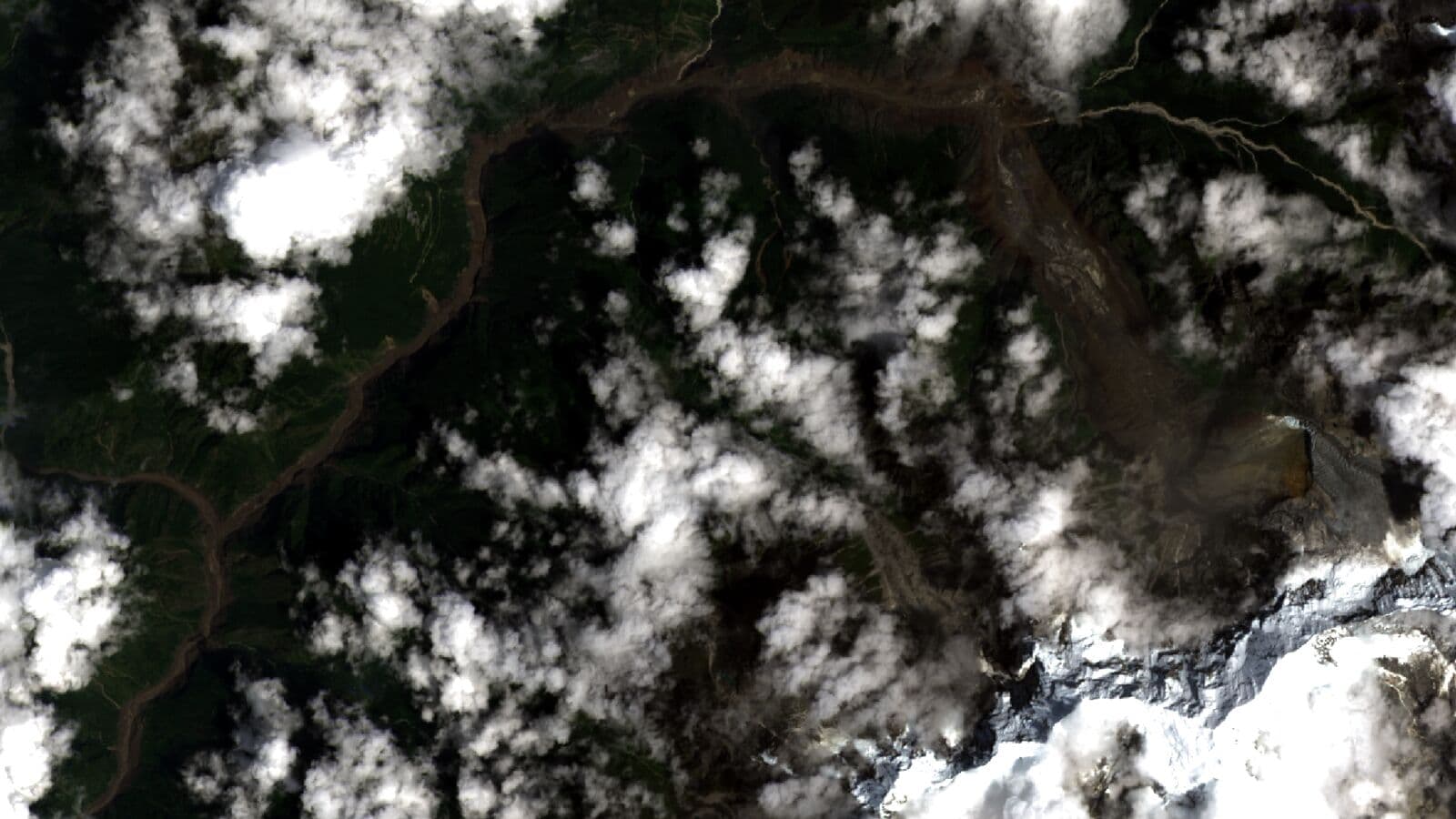
 Photo: Landsat 9 via USGS, processed by Chorchapu, Public Domain
Nepal–Tibet Floods
Overview
At about 8:37 a.m. local time on August 26, 2026, a rock-ice avalanche broke away from the Langtang Lirung massif in northern Nepal and turned into a debris flow and flash flood that tore roughly 70–100 kilometres down the Bhote Koshi–Trishuli River valley. The US Geological Survey first logged the event as a magnitude 4.4 earthquake before reclassifying the signal as a landslide and glacier collapse equivalent to magnitude 5.2. The Trishuli rose by as much as 9 metres in 30 minutes, sweeping through Rasuwa, Nuwakot, Dhading, Gorkha and Chitwan districts, and on the China border, Gyirong Port in Tibet's Gyirong County was buried.
The death toll climbed for weeks as rescuers reached cut-off communities, rising from 389 on August 28 to 1,344 by September 5. As of October 5, Reuters reported 1,455 people dead, 9,287 injured and 5,285 missing in Nepal, along with 43 dead and 519 missing in Tibet, making the flood Nepal's deadliest disaster since the 2015 earthquake. Hundreds of foreign tourists and pilgrims were among the missing. Nepal's National Disaster Risk Reduction and Management Authority had counted 13,784 people rescued across eight districts as of September 21.
About 7,570 houses were destroyed, and 12 hydropower projects were damaged, some with workers trapped in their tunnels. The flood also damaged 68 suspension bridges and 41 road bridges. Nepal estimates the damage at more than US$1.8 billion and its recovery needs at about US$4.7 billion. The government deployed 21,465 security personnel; formal search and rescue ended on October 5, and the affected area was declared a disaster zone for three months.
Within the Red Cross Movement, the IFRC released about CHF 1 million from its Disaster Response Emergency Fund and launched Emergency Appeal MDRNP022, seeking CHF 18 million, to support the Nepal Red Cross Society. The UN Central Emergency Response Fund allocated $2 million and the Loss and Damage Fund $20 million. Direct Relief has delivered 21.5 tons of medical aid and $125,000 in grants, and Samaritan's Purse reports an 85,000-pound relief airlift and help for more than 3,000 families. All Hands and Hearts is working in Nuwakot and Gorkha, including on school rebuilding, alongside International Medical Corps, Operation Blessing and the Global Empowerment Mission.
Responding Organizations
7 organizations


At a Glance
- Status
- Recovery
- Severity
- Critical
- Type
- Flood
- Affected
- 93,000+
- Responders
- 7 orgs
- Started
- August 26, 2026
Share
Help spread awareness about this disaster and the organizations responding.